 teaclass

How is Tea Made?

Tea professionals often spend years to understand just one style of tea production, so we certainly can't cover all of the nuances and varieties in one class. That said, tea production falls into one of two styles (Orthodox or Non-orthodox, the latter usually being the CTC, or 'Crush-Tear-Curl,' method), and includes five basic processing steps. These steps can be adjusted depending on the style of tea being produced.
Orthodox Production
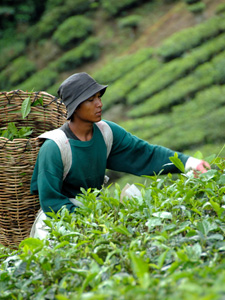
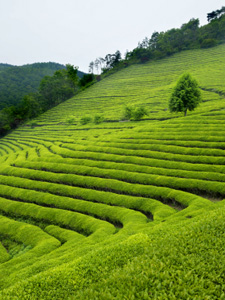
Step 1. Plucking: The leaves are harvested by hand, usually ranging between just the unopened bud to the top three leaves and the bud, depending on the tea being created. In order to make hand plucking possible, the tea "trees" are pruned into waist-high bushes. After plucking, the leaves are sorted for uniformity and any stems, twigs, broken leaves, etc. are removed.
Step 2. Withering: The leaves are laid out to wilt and wither for several hours to prepare them for further processing. Tea leaves, even fresh tender ones, aren't very pliable. Without withering, they would shatter and crumble when rolled and shaped. During withering, the leaves are very gently fluffed, rotated and monitored to ensure even exposure to the air.
Step 3. Rolling: This is where thousands of varieties in tea appearance are created, and also where the process of developing flavor is started. The softened tea leaves are rolled, pressed or twisted to break the cell walls of the leaf, wringing out the juices inside. This exposes enzymes and essential oils in the leaf to oxygen in the air - the start of oxidation.
Step 4. Oxidation: After rolling, the leaves are laid out to rest for several hours, allowing oxidation to take place. Oxidation is the process in which the oxygen in the air interacts with the now-exposed enzymes in the leaf, turning it a reddish-brown color and changing the chemical composition. This step also has the greatest impact in the creation of the many wonderful and complex flavors in tea. The length of this process depends on the style of tea being produced and the ambient conditions at the time. Depending on the type of tea, from here the leaves could be rolled again and oxidized further, or not.
Step 5. Firing: The final step in the production process is to "fire" or heat the leaves quickly to dry them to below 3% moisture content and stop the oxidation process. A good, even drying with very low residual moisture also ensures the tea will keep well.
CTC Production
CTC, or Crush-Tear-Curl production is a very different process. All five steps of Orthodox processing are performed, but much more rapidly and in a limited fashion. CTC was invented specifically for the black tea industry, in an effort to save time (a single batch of tea otherwise can take over a day to produce) and money.
The three basic differences between Orthodox and CTC teas are:
1. The appearance of the leaf Orthodox production seeks to maintain the integrity of the leaf, whether completely it's hand-made or with assistance from rolling machines and such. The tea leaves are not chopped, shredded, minced, etc. The shapes produced vary tremendously, but no matter whether it's green tea, oolong or black, Orthodox processing uses the wholeness of the leaf itself to create a diverse range of flavors in the cup. By contrast, CTC teas do not rely on the wholeness of the leaf.
2. The machinery involved CTC is produced on a machine which takes fresh, whole leaves and macerates them (crushing, tearing and curling them, hence the name). The ground up leaf is rolled into little pellets and oxidized. The tea produced visually resembles Grape Nuts cereal or large coffee grounds. Because the leaf is completely broken up, every part of the process moves very quickly. A whole batch can take just two hours. In Orthodox processing, while some tea leaves can look very small at the end, the leaves are never intentionally cut or torn apart. They are carefully rolled and handled just enough to produce a certain flavor, and their production relies on true tea artisans who have trained for years - in many cases, generations - to make that specific tea.
3. The flavor profile As mentioned, CTC was invented specifically for black tea production. These fast-infusing teas are ideal for the tea bag industry, as well as for use in spicy chai blends and iced tea (because of the color). Their flavor is very one-dimensional: bold, powerful and brightly coloring with a pungent astringency. Orthodox teas - because the leaf is not treated the same way - don't produce this type of color and body. However, CTC cannot produce the tremendous range of flavor and aroma which Orthodox teas are loved for. First of all, you can't use the CTC method to make white teas, oolongs, etc. The shredded leaf oxidizes too quickly. There are a few CTC green teas, but this is accomplished by steaming the leaves to prevent oxidation. That's about as elaborate as it gets. Secondly, because Orthodox production requires so much time, the tea maker is able to draw out and develop very nuanced flavors. Everything done to the leaf will alter the flavor of the tea.
Why roll tea leaves?
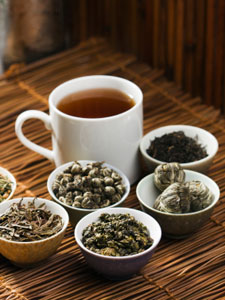
Orthodox teas can be found in an incredible variety of shapes and sizes, from long needles to tightly rolled gunpowder balls. In China especially, the quality and style of the leaf is prized as much or more than the actual taste of the brew.
The practice of rolling tea leaves helps to preserve the essential oils, which contribute to the wonderful aroma of tea. Tightly rolled teas also store better, which was important in the early days of tea trade, as the journey from place to place could take months or years.
The CTC process of chopping the leaves into small, uniform pieces makes it impossible for the leaf to hold on these essential oils. CTC teas also lose their flavor and quality much more quickly. Loose tea, if properly stored, can keep for up to 2 years. CTC teas typically keep their best taste for only 4-6 months.
The reality of the tea bag industry is that, by the time the tea bag reaches the customers cup, the tea is often already more than 6 months old and is past its prime. To combat this, some specialty tea companies are now offering whole leaf teas in larger, pyramid bags or sachets. These new offerings make it possible to sell the same tea in a bag that one might find loose in the world's finest tea shops. While this IS possible, buyer beware - most bagged teas are still not very fresh.