 teaclass
Yixing Clay
YIXING: The Clay Teapots of Jiangsu Province
As tea enthusiasts drink their way through legendary examples from around the world, one stop along the road through teadom is to admire, and hopefully purchase, the seminal classic tea vessel of mainland China, an Yixing (ee-ching) clay teapot for their Lung Ching or Keemun or Ti Kuan Yin...
WHAT ARE YIXING POTS?
To look at designs from centuries ago is to marvel that the simple designs are as elegant and "now" as today's fashions and the fanciful motifs and shapes are as delightful as they must have been for the elite, the royal, the ordinary tea drinker.
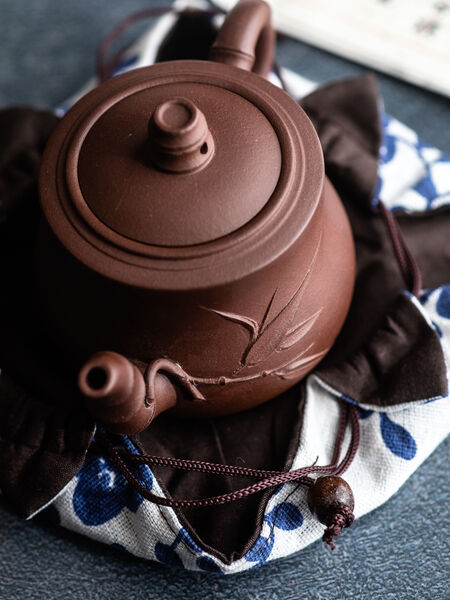
Both esteemed artists and anonymous potters still produce Yixing pots in the traditional way, with the clay thrown countless times to eliminate air bubbles, then shaped by hand or formed in molds into sleek smooth shapes or those that imply lotus flowers, mythic dragons, amusing monkeys; geometric shapes plain or festooned with designs imagined by the creative artisans. The pots are usually done by hand, often on a potter's wheel and stamped with their chop mark under the lid or on the bottom of the pot or, rarely, on the handle. The unique qualities of zisha clay offer both flexibility and firmness making it the ideal clay for craftsmen to wield into fanciful or elegant shapes and designs without the fear that shrinkage from firing will compromise their designs. This clay is fashioned into more than teapots; it is used in bowls, cups, jars, dishes and tiles for building roofs. Yixing (pronounced ee-ching) refers to an area that is about 120 miles northwest of Shanghai in Jiangsu province which has rich deposits of an iron-rich, 100% non-toxic clay that the Chinese refer to as zisha for the purple hue that is most common in these deposits. Most Chinese refer to Yixing pots as zisha pots.
Yixing clay deposits can be green, yellow and turquoise although purple is the most abundant. Different colors can also be achieved with the addition of mineral pigments such as mixing cobalt oxide with zisha to make black, magnesium oxide with zisha to make a blue color. Pots made from the almost cinnabar red clay are known as zhuni and a favorite among the Chinese who value the color red in their culture.
The clay takes to the kiln easily and produces a distinctive, almost satin finish due to its exceptionally high iron content. Despite the temperatures used to fire the clay (about 2192 degrees F. ), it remains highly porous, thus avoiding the crystalizing, cracking or melting that happens with other clays. Water does not seep out, temperatures are retained during the brewing process and the clay will not crack when hot or even boiling water is poured into the pot.
HOW TO BUY:
Yixing teapots are commonly made by machine today and highly popular because they emulate classic designs and are relatively inexpensive. Some are not actually made with the clay from Jiangsu province but similar clays found elsewhere in the world from other places in China, Taiwan and even the U.S. They are a good way to practice brewing and drinking from an Yixing pot without making a big investment, however, they can be vulnerable to cracking and breakage because of careless firing and, of course, the use of non-zisha clay can compromise the taste of the tea brewed in them. Genuine Yixing clays do not have lead, arsenic, cadmium or other toxic elements. Inexpensive pots range from $10 to $50.
Artisan-made or antique Yixing pots, although made to last for decades, also must be handled with gentleness. Hand-made pots can cost from under one hundred dollars to several hundred dollars depending on the artist's reputation and skill and whether it is of museum quality or antique. Always work with a reputable dealer when purchasing an antique Yixing pot, especially if the dealer claims they date from well-known dynasties. Those from the Sung Dynasty (960-12379), when zisha was first mined near Lake Taihu, are exceptionally rare, small and were primarily owned by royalty or the elite.
During Ming Dynasty (1368-1644), the unpretentious yet elegant designs evolved followed by the fanciful decorations for which the Qing Dynasty (1644-1011) was noted for, using themes from nature: plants, tree ranches and trunks, insets, birds, rocks and flowers, or fluted or ribbed markings or geometric shapes like cylinders, spheres, cubes, rectangles and variables on all these themes. Designs from these eras are frequently duplicated both by today's Yixing manufacturers and by "national treasure" artisans and craftsmen so you can get the pleasure of these beautiful designs without the heavy price tag of a genuinely antique pot which cost thousands of dollars.
HOW TO USE:
The first, and foremost, criterion is to decide what tea you will dedicate each pot to; not any easy decision! Large pots are good for puerhs or blacks; they are most commonly used in Northern China. These are perfect for the types of teas you would serve family style or with a group of friends. Medium pots that brew enough for two to four people are good for blacks or oolong. Use two to three-ounce cups with these pots.
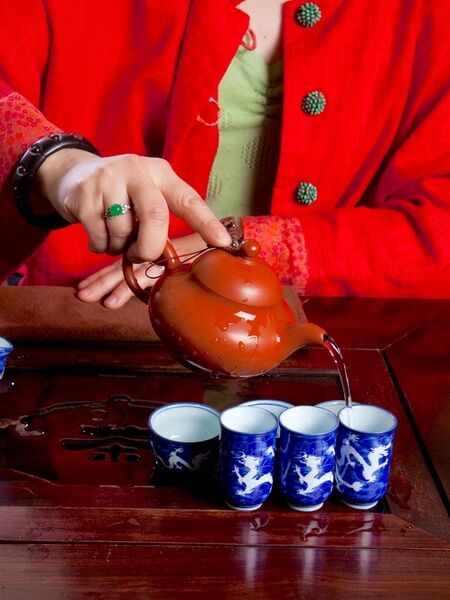
Small pots, about two to three inches in diameter, are best used for gong fu service to brew high-quality oolongs or delicate greens and to pour into thimble cups. Small pots with thimble cups are certainly the most traditional for individual use in the provinces of Fujian, Canton and throughout South China.
Yixing teapots must be dedicated to one type of tea per pot because the unglazed clay is quite porous, and absorbs the natural oils and aroma of the tea so much so that, after years of enjoyment, a pot offers a delicate version of the tea when only hot water is left in the pot for several minutes. An Yixing pot must be seasoned before using by placing the type of tea you intend to use, pouring hot water over the outside of the pot, top to bottom, and then inside the pot completely covering the tea so that the water reaches just under the lid. Allow it to sit a few minutes, then discard both tea leaves and liquor out. Yes, it seems like a waste of good tea, but this first brewing is necessary to rinse the pot of any dust from the clay and prepare it to hold your choice of tea for subsequent brewing. After each use, rinse the pot with hot water and leave upside down in a dish rack to completely dry out or dry it manually inside and out with a clean soft cotton cloth also dedicated to that purpose. Never use a scrub brush and absolutely never use soap.